

Why Temperature Range Matters When Selecting Piping Materials
In piping system design, material selection is not only about pressure rating, pipe size or installation cost. Temperature performance is one of the most important factors that determines long-term reliability, especially in systems exposed to hot water, chemical fluids, temperature cycling or demanding industrial environments.
The performance of a piping material can change significantly when temperature moves from low-temperature conditions to high-heat operating environments. A material that performs well at room temperature may become brittle in cold conditions, soften under heat, or suffer corrosion-related degradation over time.
This is why engineers and project buyers often compare PVC, CPVC and metal piping materials when evaluating system stability, service life and maintenance risk.
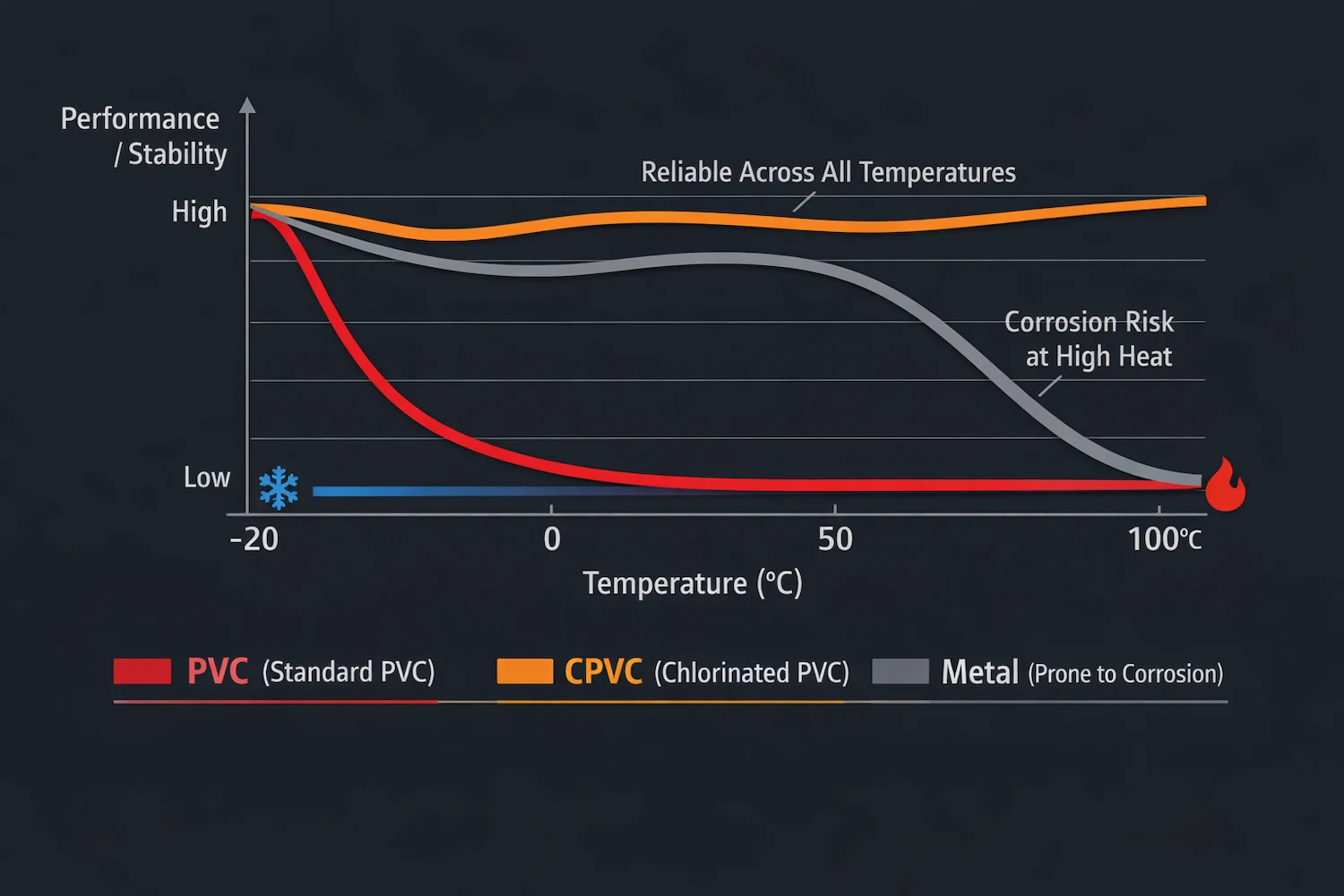
The chart below illustrates a general performance comparison across temperature conditions. It shows how standard PVC, CPVC and metal materials respond differently as the operating environment moves from approximately -20°C to 100°C.
I. Understanding the Temperature Performance Curve
The chart compares three common piping material categories:
- PVC — standard polyvinyl chloride;
- CPVC — chlorinated polyvinyl chloride;
- Metal — traditional metallic piping materials that may be exposed to corrosion risk depending on the fluid and environment.
The vertical axis represents performance and stability, while the horizontal axis represents temperature. Although the chart is a conceptual comparison rather than a replacement for project-specific engineering calculation, it helps explain an important material selection principle:
Different piping materials do not maintain the same level of stability across changing temperature conditions.
For buyers and engineers, this means the right material should be selected according to the real operating environment, not only the initial purchase cost or nominal specification. For project teams that need more technical support, JARO’s engineering validation and quality assurance process helps connect material selection, testing logic and long-term system reliability.
II. Standard PVC: Reliable in Many Applications, but Limited by Temperature
Standard PVC is widely used in water supply, drainage, irrigation and general fluid handling applications. It is lightweight, cost-effective, easy to install and resistant to many common forms of corrosion. For normal-temperature systems, PVC remains a practical and widely accepted material.
However, standard PVC has clear limitations when the operating temperature becomes more demanding.
At low temperatures, PVC may lose impact toughness and become more sensitive to cracking under sudden load or mechanical impact. At higher temperatures, PVC may gradually lose dimensional stability and pressure-bearing capability because thermoplastic materials generally become softer as temperature increases.
This does not mean PVC is unsuitable as a piping material. It means PVC should be used within its appropriate service range. For applications involving high-temperature fluid, hot water circulation or repeated thermal cycling, standard PVC may not provide enough long-term safety margin.
In practical material selection, PVC is often better suited for normal-temperature water systems, irrigation networks, drainage systems and general low-to-medium temperature fluid applications. For applications requiring recognized compliance support, buyers may also review JARO’s certified plastic valves and fittings to better match material choice with market requirements.
III. CPVC: Designed for Better Stability Across Wider Temperature Conditions
CPVC, or chlorinated polyvinyl chloride, is developed by increasing the chlorine content of PVC resin. This chemical modification improves heat resistance and allows CPVC to maintain better stability under elevated temperature conditions. Oatey explains that CPVC is made by adding chlorine to standard PVC, improving heat tolerance and chemical durability in suitable applications according to its PVC vs CPVC material guide.
Compared with standard PVC, CPVC provides stronger thermal stability, better high-temperature resistance and improved suitability for hot water or high-temperature fluid systems. Charlotte Pipe also describes CPVC Schedule 80 pipe as having higher temperature capabilities than PVC for commercial and industrial pressure applications in its CPVC Schedule 80 pipe specification page.
This is why CPVC is commonly used in applications such as:
- hot water piping systems;
- industrial fluid transportation;
- chemical-resistant piping systems;
- high-temperature water treatment applications;
- process piping where temperature stability is required.
In the chart, CPVC is represented by the orange curve, which remains relatively stable across a wide temperature range. This reflects the key engineering advantage of CPVC: it can retain performance more effectively when temperature conditions become more demanding.
For projects where the fluid temperature may rise, fluctuate or remain elevated for long operating periods, CPVC piping materials offer a stronger long-term reliability margin than standard PVC.
IV. Metal Piping: Strong, but Not Always the Most Stable Long-Term Choice
Metal piping has traditionally been used in many pressure and temperature-demanding systems because of its mechanical strength. However, metal is not automatically the best solution in every fluid environment.
The main concern with metal piping is not only temperature, but also corrosion risk. When metal pipes are exposed to certain chemicals, aggressive water conditions, high humidity or elevated temperatures, corrosion may accelerate and gradually reduce system reliability.
Corrosion can lead to:
- wall thickness reduction;
- internal scaling or contamination;
- flow restriction;
- higher maintenance requirements;
- leakage risk;
- shorter service life in aggressive environments.
In the chart, the metal curve declines under high-heat conditions due to the potential risk of corrosion-related performance loss. This does not mean all metal piping fails under heat. Rather, it highlights that metal performance depends heavily on fluid chemistry, protective treatment, material grade and maintenance conditions.
For many chemical, hot water and corrosion-sensitive systems, CPVC can provide a practical alternative to metal piping by combining temperature resistance with non-metallic corrosion resistance. Corzan notes that CPVC piping systems offer corrosion resistance compared with galvanized steel, while metals may suffer pitting or crevice corrosion depending on the environment in its CPVC vs steel piping comparison.
V. Why CPVC Performs Better Than PVC at Higher Temperatures
The key difference between PVC and CPVC comes from molecular structure. CPVC contains a higher level of chlorine than standard PVC, which improves the material’s resistance to thermal deformation and allows it to perform better under elevated temperatures.
This improved heat resistance helps CPVC maintain:
- better dimensional stability;
- higher thermal resistance;
- more reliable pressure performance at elevated temperatures;
- improved resistance to hot water and certain chemical fluids;
- longer service potential in high-temperature environments.
For system designers, the advantage is clear. When the application environment moves beyond the comfortable operating range of standard PVC, CPVC becomes a more suitable engineering material for thermal stability and long-term reliability.
This is why JARO evaluates high-temperature plastic piping solutions from a full system perspective, including material selection, dimensional control, pressure performance and batch consistency. These factors are supported by stable manufacturing systems, mold precision and controlled production processes.
VI. Where CPVC Piping Systems Are Most Suitable
CPVC is especially valuable in applications where standard PVC may not offer enough temperature resistance and where metal may create corrosion or maintenance concerns.
Typical CPVC application environments include:
- Hot water distribution systems where long-term thermal stability is required;
- Industrial fluid systems involving elevated temperature or chemical exposure;
- Water treatment facilities where corrosion resistance and fluid compatibility are important;
- Chemical processing lines where metal corrosion may become a risk;
- High-temperature utility systems requiring stable non-metallic piping solutions.
For these applications, the value of CPVC is not only its high-temperature resistance. It also helps reduce the corrosion-related issues often associated with metal piping, while offering easier handling and installation compared with many metallic systems.
In hot and cold water distribution, the Plastics Pipe Institute notes that plastic plumbing pipes do not corrode or suffer scale build-up that can reduce flow, and that CPVC is commonly used in trunk-and-branch configurations for rigid piping layouts on its hot and cold water plumbing distribution page.
VII. How to Choose Between PVC, CPVC and Metal Piping Materials
There is no single material that fits every piping system. The correct choice depends on temperature, pressure, fluid chemistry, installation environment, maintenance requirements and project budget.
As a general selection guide:
- Choose PVC for normal-temperature water systems, irrigation networks, drainage systems and cost-sensitive general applications.
- Choose CPVC for hot water, higher-temperature fluid handling, chemical-resistant piping and systems requiring improved thermal stability.
- Choose metal piping when very high mechanical strength, specific code requirements or extreme pressure conditions are the main priority, while carefully evaluating corrosion risk.
For many modern fluid handling systems, CPVC provides a strong balance between temperature resistance, corrosion resistance, installation efficiency and long-term system reliability.
Buyers comparing pressure classes, international specifications or project requirements can also use JARO’s PN to PSI and BAR conversion tool to support pressure rating comparison across different markets.
VIII. Why This Matters for Global Buyers and Project Distributors
For distributors, wholesalers and project buyers, material selection directly affects customer satisfaction, warranty pressure and long-term brand reputation. A piping system failure is rarely judged only by the failed component. Customers often evaluate the entire supplier system behind the product.
Choosing the right material from the beginning helps reduce:
- premature leakage;
- thermal deformation;
- corrosion-related complaints;
- maintenance frequency;
- replacement cost;
- project risk.
This is especially important for markets where water quality, temperature variation and installation environments differ widely. A product that performs well in one region may not deliver the same reliability in another if material selection is not properly matched to the application.
For this reason, JARO evaluates piping material solutions not only from a product catalog perspective, but also from a system performance perspective. Temperature range, pressure rating, chemical compatibility and service environment should all be considered before selecting PVC, CPVC or metal alternatives.
For buyers who need broader technical guidance, JARO’s plastic valves and fittings FAQ provides additional explanations on material selection, pressure ratings, certifications and application matching.
Conclusion: CPVC Offers a Stronger Stability Margin in High-Temperature and Corrosion-Sensitive Systems
The comparison between PVC, CPVC and metal piping materials shows that temperature performance is a critical factor in long-term system reliability.
Standard PVC remains a practical solution for many normal-temperature applications, but its performance margin becomes more limited under high-temperature or severe thermal cycling conditions. Metal piping offers mechanical strength, but may face corrosion-related risks depending on fluid chemistry and operating environment.
CPVC provides a balanced solution for applications requiring higher temperature resistance, improved corrosion resistance and long-term material stability. For hot water systems, chemical-resistant piping and demanding industrial fluid applications, CPVC can offer a more reliable alternative when standard PVC is not sufficient and metal introduces corrosion or maintenance concerns.
For project buyers and distributors, the key is not simply choosing the strongest-looking material. The real value comes from choosing the material that maintains stable performance across the actual operating temperature range of the system.
Explore JARO’s engineering validation and quality assurance approach to understand how material selection, testing standards and production control support long-term plastic piping system reliability.
Frequently Asked Questions
1. What is the main difference between PVC and CPVC?
The main difference is chemical structure and temperature resistance. CPVC contains more chlorine than standard PVC, which improves its heat resistance and makes it more suitable for hot water and higher-temperature fluid applications.
2. Is CPVC better than PVC for hot water systems?
Yes. CPVC is generally more suitable than standard PVC for hot water systems because it can maintain better dimensional stability and mechanical performance at elevated temperatures.
3. Can CPVC replace metal piping?
In some applications, CPVC can be used as an alternative to metal piping, especially where corrosion resistance, chemical compatibility and easier installation are important. However, final material selection should always consider pressure, temperature, fluid type and project requirements.
4. Why does metal piping have corrosion risk at high temperature?
Higher temperature can accelerate chemical reactions in some fluid environments, which may increase corrosion risk for certain metals. The actual risk depends on the metal grade, fluid chemistry, protective treatment and operating conditions.
5. Is PVC suitable for low-temperature applications?
PVC can be used in many normal environments, but at lower temperatures it may become more sensitive to impact and cracking. For cold environments, material grade, formulation and installation conditions should be carefully evaluated.
6. Which material should be selected for chemical-resistant piping?
CPVC is often a strong option for chemical-resistant piping because it combines non-metallic corrosion resistance with better temperature performance than standard PVC. However, chemical compatibility should always be checked according to the specific fluid.
7. What should buyers consider when comparing PVC, CPVC and metal piping?
Buyers should consider temperature range, pressure rating, corrosion risk, chemical compatibility, installation cost, maintenance requirements and long-term system reliability. Material selection should be based on real operating conditions rather than price alone.