

A Technical Insight into Polypropylene Aging, Surface Chalking and Outdoor Durability of PP Compression Fittings
Document No.: RD-PP-SPEC-2026
Issuing Department: Technical R&D Center / Quality Control Department
Product Category: PP compression fittings
Application Focus: Agricultural irrigation, outdoor water supply, above-ground piping systems and long-term field installations
Introduction
PP compression fittings are widely used in agricultural irrigation, water supply systems and outdoor plastic piping networks because they are lightweight, easy to install and resistant to many common forms of corrosion. However, in long-term outdoor applications, some polypropylene fittings may gradually show visible surface whitening, chalking or brittleness after continuous exposure to sunlight, heat, oxygen and changing environmental conditions.
This phenomenon is not only a matter of appearance. In many cases, surface chalking is the first visible sign of ultraviolet aging inside the polymer material. If the material formulation, UV stabilization system and structural design are not properly controlled, the fitting may lose tensile strength, impact resistance and long-term pressure stability over time.
For PP compression fittings, outdoor durability is therefore determined by more than nominal pressure rating or wall thickness. It depends on a combined system of material selection, UV-resistant formulation, carbon black dispersion, locking-ring design, sealing structure and manufacturing consistency.
This technical article explains why PP fittings turn white outdoors, how ultraviolet radiation affects polypropylene materials, why carbon black is an effective UV protection system, and how advanced material formulation and structural design can improve the long-term service life of PP compression fittings in demanding field environments.
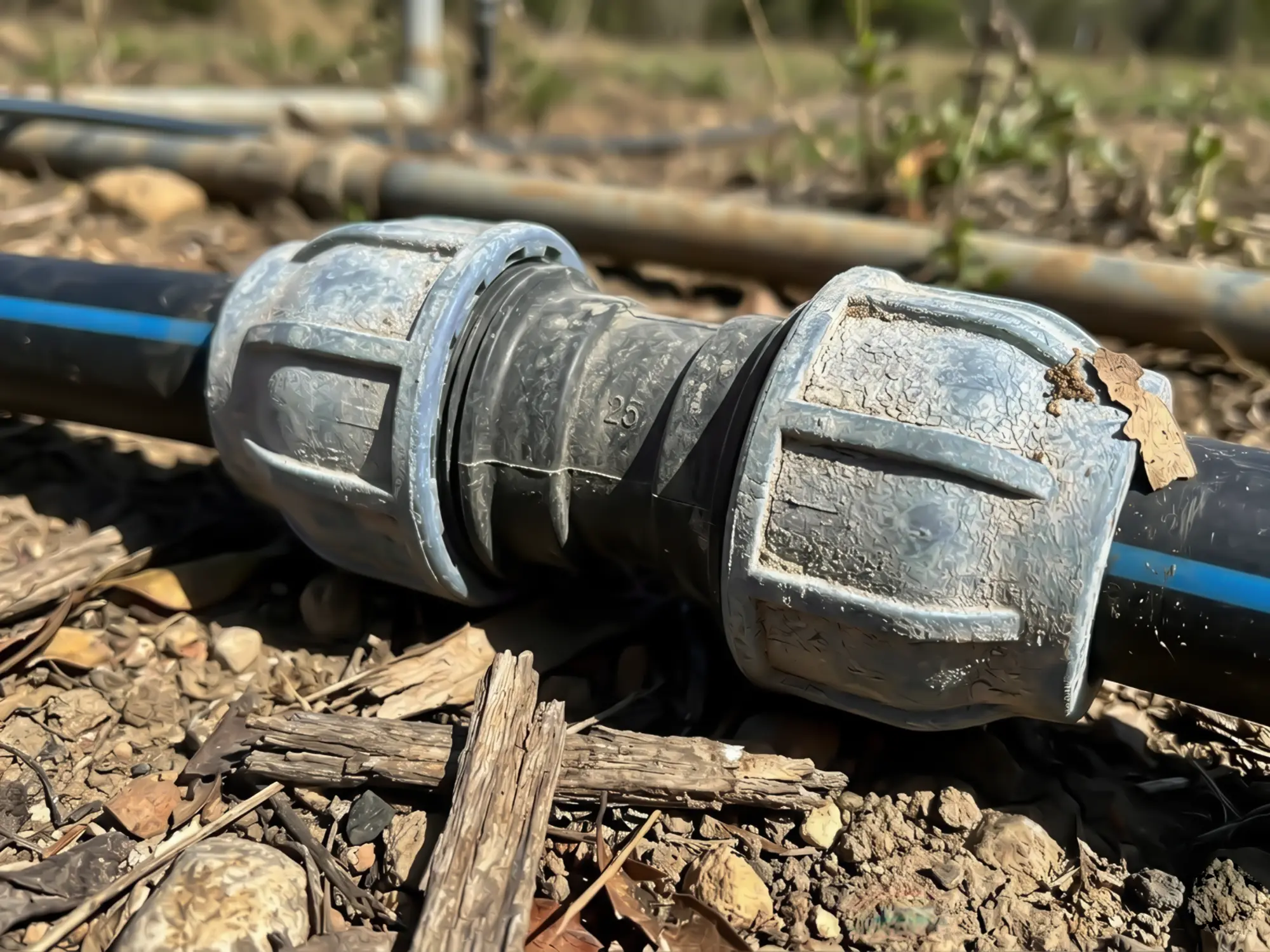
I. Why Do PP Compression Fittings Turn White After Long-Term Sun Exposure?
When polypropylene compression fittings are installed in open-air environments, they are continuously exposed to ultraviolet radiation, oxygen, heat, moisture and mechanical stress. Over time, these environmental factors can trigger a material aging process known as photo-oxidative degradation.
The most visible result of this process is often surface chalking.
Surface chalking refers to the white, powder-like layer that appears on the surface of aged plastic parts. In PP compression fittings, this usually occurs when UV radiation breaks down the molecular structure near the surface of the polypropylene material. As the surface layer degrades, it loses gloss, becomes rougher and begins to form a pale or powdery appearance.
At the early stage, chalking may look like a cosmetic issue. However, if UV degradation continues, the surface damage can gradually move deeper into the material. This may reduce mechanical properties such as tensile strength, elongation at break and impact resistance. In irrigation systems, outdoor water supply lines and above-ground pipe networks, this type of aging can eventually increase the risk of cracking, leakage or fitting failure under pressure fluctuations and water hammer conditions.
1. UV Radiation Starts the Degradation Process
Polypropylene is a hydrocarbon polymer. Its molecular chains contain tertiary carbon atoms, which are relatively sensitive to ultraviolet radiation, especially in outdoor environments with long-term sun exposure.
When PP compression fittings are exposed to sunlight, ultraviolet rays with wavelengths typically between 290 nm and 400 nm can provide enough energy to break chemical bonds within the polymer chain. This process generates free radicals inside the surface layer of the material.
These free radicals are highly reactive. Once formed, they begin a chain reaction that accelerates the aging of the polypropylene structure.
In practical terms, this means that a PP fitting exposed to outdoor sunlight does not simply “fade” on the surface. The material itself begins to experience molecular-level changes, starting from the outer layer and gradually influencing the mechanical integrity of the part.
2. Oxygen Accelerates Polymer Aging
UV radiation alone is not the only cause of aging. Oxygen in the air plays an equally important role.
After free radicals are generated by sunlight, they react with atmospheric oxygen and form oxidation products such as peroxides, carbonyl groups and other oxygen-containing compounds. This reaction is known as photo-oxidation.
Photo-oxidation causes the polypropylene molecular chains to break into shorter segments. As the molecular weight decreases, the material becomes less flexible and less capable of absorbing stress.
For compression fittings, this is especially important because the product must maintain strength not only as a molded plastic part, but also as a functional pressure-bearing component. It must resist pipe movement, installation torque, internal water pressure, temperature changes and repeated mechanical loading during long-term service.
Once oxidation reduces material toughness, the fitting becomes more vulnerable to cracking or brittle failure.
3. Surface Chalking Is the Visible Sign of Material Breakdown
The white or grey powder that appears on aged PP fittings is the visible result of polymer degradation at the surface.
As the outer layer of polypropylene breaks down, the degraded material loses cohesion. The surface becomes rough, porous and weak. This produces the familiar chalky appearance often seen on outdoor plastic components after long periods of exposure.
For users in the field, this whitening effect can be misleading. Some fittings may look aged but still retain acceptable strength, while others may have already suffered significant mechanical loss beneath the surface.
Therefore, appearance alone should not be used as the only indicator of serviceability. The real question is whether the fitting can still maintain its tensile strength, impact resistance, sealing stability and pressure-bearing performance after environmental exposure.
This is why weatherability testing and material formulation control are essential for PP compression fittings designed for outdoor use.
4. Long-Term Aging Can Lead to Brittleness and Failure
If UV degradation is not controlled, the aging process does not stop at surface chalking.
Over time, molecular chain scission continues, oxidation deepens, and micro-cracks may begin to form in the weakened surface layer. These micro-cracks can expand under mechanical stress, especially in systems exposed to pressure cycling, pipe vibration, thermal expansion, soil movement or water hammer.
The most common performance risks include:
- reduced tensile strength;
- lower elongation at break;
- reduced impact resistance;
- surface micro-cracking;
- brittle fracture under sudden load;
- sealing instability caused by structural deformation;
- increased risk of leakage under pressure fluctuation.
For agricultural irrigation and outdoor water distribution systems, these risks are particularly important. Fittings are often installed above ground, exposed to direct sunlight for many years, and subjected to repeated opening, closing, movement and pressure changes.
This means that a reliable PP compression fitting must be engineered not only for initial pressure performance, but also for long-term retention of mechanical properties under outdoor aging conditions.
5. Why Weatherability Matters for PP Compression Fittings
In many markets, buyers compare PP compression fittings mainly by size, pressure rating, color and price. However, these factors do not fully explain long-term product reliability.
Two fittings with the same nominal size and same pressure rating may perform very differently after several years outdoors if their material formulation and UV stabilization systems are different.
For example, an unstabilized or poorly stabilized light-colored PP fitting may show rapid chalking, embrittlement and strength loss under intense sunlight. In contrast, a properly formulated carbon-black-enhanced PP fitting can maintain much better resistance against UV radiation, oxidation and mechanical degradation.
This difference directly affects:
- service life;
- maintenance frequency;
- field failure risk;
- replacement cost;
- distributor warranty pressure;
- project reliability;
- long-term brand reputation.
For this reason, weatherability should be considered a core performance requirement for PP compression fittings used in irrigation, outdoor water supply and exposed piping systems.
A high-quality fitting is not only expected to pass pressure testing when it leaves the factory. It must also retain sufficient structural performance after years of sunlight exposure, temperature cycling and field operation.
II. Why Carbon Black Is the Key to Outdoor UV Resistance
Among the different UV stabilization methods used in polypropylene materials, carbon black is one of the most effective and widely recognized solutions for long-term outdoor applications. Its main function is to absorb and block ultraviolet radiation before it penetrates deeper into the polymer structure.
For PP compression fittings, this is especially important because the product is not a decorative plastic part. It is a functional piping component that must maintain sealing stability, locking strength and pressure resistance during long-term field operation.
When carbon black is properly selected and evenly dispersed in the PP matrix, it forms a protective shielding system within the material. This helps reduce UV penetration, slow photo-oxidative degradation and improve long-term mechanical property retention.
This is why black PP compression fittings are often preferred for above-ground irrigation systems, open-air water supply lines and exposed outdoor piping networks.
1. Color Is Not Only a Visual Choice
In PP compression fittings, appearance color is not only a matter of brand identity or product recognition. In many cases, it also indicates different functional positioning and application environments.
For example, jet black fittings are more suitable for long-term direct sunlight exposure because carbon black provides stronger UV protection. Light blue fittings may still be suitable for indoor installations, underground networks or facility rooms, but they are not always the best option for long-term exposed outdoor environments.
The following comparison shows how different appearance colors can be associated with different functional requirements and application scenarios:
| Appearance Color | Functional Indicator | Recommended Application Environment | UV Resistance Rating |
|---|---|---|---|
| Jet Black | Premium Weatherproof Series | Above-ground, open-air fields, long-term direct sunlight exposure | ⭐⭐⭐⭐⭐ |
| Orange | Alert / Fire-Protection / Fluid ID | Specific fluid loops, fire-protection branches, quick-identification zones | ⭐⭐⭐ |
| Dark Blue | Enhanced Contrast Series | Low-light zones, partially shaded outdoor applications | ⭐⭐⭐ |
| Light Blue | Standard Engineering Series | Indoor installations, underground networks, or plant facility rooms | ⭐⭐ |
This comparison does not mean that color alone determines product quality. The real performance depends on material formulation, additive system, carbon black dispersion quality and manufacturing consistency. However, for outdoor applications, color and formulation should be considered together instead of being treated as a simple visual preference.
2. Carbon Black Works as a UV Shielding System
Carbon black improves weatherability mainly through UV absorption and energy dissipation. When sunlight reaches the fitting surface, properly dispersed carbon black particles absorb a significant portion of the ultraviolet radiation and reduce the amount of UV energy that reaches the polypropylene molecular chains.
This helps slow the generation of free radicals, reduces oxidation speed and limits the depth of material degradation. As a result, the fitting can retain better ductility, impact resistance and pressure-bearing reliability after long-term exposure, especially in PP compression fittings for outdoor irrigation and water supply systems.
In engineering terms, carbon black does not simply make the product black. It functions as a material-level protection system that directly influences outdoor service life. This material strategy should be evaluated together with engineering validation and quality assurance to ensure stable long-term product performance.
III. Laboratory Testing Results: UV Stabilization and Mechanical Property Retention
To evaluate the influence of UV stabilization on long-term outdoor durability, comparative testing was carried out between standard light blue PP material without sufficient UV protection and jet black PP material enhanced with carbon black.
The purpose of this comparison is to show how different formulations retain mechanical properties after accelerated weathering exposure. For PP compression fittings, this type of testing is important because a fitting may pass pressure testing when new, but its long-term field performance depends on how well the material resists UV aging, oxidation and embrittlement.
1. Comparison of Mechanical Property Retention After Accelerated Weathering
| Test Item | Test Standard | Standard Light Blue PP (Unprotected) | Jet Black PP (Carbon Black Enhanced) | Performance Improvement |
|---|---|---|---|---|
| Accelerated Weathering | ASTM G154 (2000h) | Severe surface chalking & embrittlement | Smooth surface; zero macro-cracking | — |
| Tensile Strength Retention | ISO 527 | Only 28% remaining | 94% Retained | 3.3x Higher |
| Elongation at Break | ISO 527 | < 5% (Extremely brittle) | > 80% (Highly ductile) | 16x Higher |
| Impact Resistance | ISO 179 | High susceptibility to fracturing | Maintained excellent impact toughness | Significant |
2. What These Results Mean for Outdoor Applications
The test results show that UV stabilization has a direct influence on the long-term mechanical reliability of PP compression fittings. After accelerated weathering exposure, the standard light blue PP material showed severe chalking, embrittlement and significant loss of mechanical strength. In contrast, the carbon-black-enhanced jet black PP material maintained a smooth surface and retained much higher tensile strength, ductility and impact toughness.
This means that outdoor durability is not only determined by the initial pressure rating of a fitting. A product with poor UV resistance may perform well at the beginning, but gradually lose mechanical reliability after years of sunlight exposure.
For distributors, contractors and engineering buyers, this distinction is critical. A fitting that maintains higher property retention after UV exposure can reduce the risk of field cracking, leakage, replacement cost and warranty pressure.
Section Summary
Surface whitening and chalking of PP compression fittings are caused by photo-oxidative degradation of polypropylene under long-term UV exposure.
The process begins with molecular chain damage, accelerates through oxygen reaction, appears visibly as surface chalking, and may eventually reduce tensile strength, impact resistance and pressure reliability.
Carbon black helps protect PP materials by absorbing ultraviolet radiation and slowing the degradation process. When properly formulated and evenly dispersed, it can significantly improve the long-term retention of tensile strength, elongation and impact resistance, especially in applications evaluated under ASTM G154 accelerated UV weathering and related plastics performance tests.
The testing comparison also shows that outdoor durability should not be judged by appearance or initial pressure rating alone. For exposed irrigation systems and above-ground piping networks,UV-resistant formulation, mechanical property retention and manufacturing consistency
are essential factors in long-term product reliability. Mechanical retention should be reviewed together with recognized plastics testing methods such as ISO 527 tensile property testing and ISO 179 impact resistance testing.
IV. Why Structural Design Matters as Much as Material Formulation
Material formulation is the foundation of outdoor durability, but it is not the only factor that determines the long-term reliability of PP compression fittings. Even when the material has strong UV resistance, poor structural design can still lead to leakage, pipe pull-out, cracking or unstable sealing under field conditions.
In real irrigation and outdoor water supply systems, fittings are exposed not only to sunlight, but also to internal pressure, pipe movement, installation torque, temperature changes and repeated mechanical loading. This means that a high-performance PP compression fitting must combine weather-resistant material formulation with pressure-bearing structural design.
For this reason, JARO develops PP compression fittings as a complete engineering system rather than a single molded plastic part. The goal is to maintain stable performance from initial installation to long-term outdoor service.
1. Pressure Rating Must Be Supported by Structural Strength
Pressure rating is one of the most visible specifications in PP compression fittings. However, a pressure rating is meaningful only when it is supported by material strength, wall thickness, dimensional stability and reliable sealing design.
In outdoor systems, fittings may experience pressure fluctuations caused by pump start-up, valve operation, water hammer or uneven field pressure distribution. If the fitting body is not properly reinforced, repeated pressure cycles may increase the risk of deformation, leakage or cracking.
A well-designed fitting should therefore provide more than short-term pressure resistance. It should maintain structural stability under repeated field conditions, especially in irrigation systems and above-ground water distribution networks where pressure changes are common.
This is why PN10 and PN16 pressure performance should be evaluated together with material formulation, sealing structure and locking-ring reliability.
2. Wall Thickness and Reinforcement Help Resist Deformation
The fitting body must remain dimensionally stable during installation and operation. If the wall thickness is insufficient or the stress distribution is poorly controlled, the fitting may deform under pressure or tightening force.
Proper wall thickness design helps distribute internal pressure more evenly across the body of the fitting. Reinforced structural areas can also reduce stress concentration around threaded zones, sealing areas and pipe connection points.
For long-term outdoor applications, this becomes even more important because material aging, temperature cycling and mechanical loading occur at the same time. A fitting that appears strong when new may not maintain the same reliability after years of UV exposure and pressure cycling if the structure is too weak.
JARO focuses on structural consistency in molding and product design to support stable pressure resistance, controlled deformation and long-term sealing reliability.
3. Locking Ring Design Affects Pull-Out Resistance
In PP compression fittings, the locking ring is one of the most important functional components. Its role is to grip the pipe, resist pull-out force and help maintain a stable connection under pressure and pipe movement.
In field installations, pipes may move because of temperature expansion, soil settlement, vibration, water hammer or manual handling during installation. If the locking ring cannot grip the pipe firmly, the connection may loosen over time, increasing the risk of leakage or pipe separation.
JARO applies an Eagle-Claw locking ring design to improve pipe-gripping stability. The locking structure is designed to provide stronger engagement with the pipe surface and help resist axial movement during operation.
This design is especially valuable for irrigation systems, agricultural water lines and outdoor piping networks where pipes may be exposed to frequent movement, uneven terrain and long installation distances.
4. Sealing Stability Depends on Both Material and Geometry
A compression fitting must maintain sealing performance over time. This requires more than a good rubber seal. The body geometry, nut tightening force, sealing surface, pipe engagement depth and dimensional accuracy all influence the final sealing result.
If the fitting body deforms, if the pipe is not held securely, or if the sealing area loses contact pressure, leakage may occur even when the material itself has good UV resistance.
Therefore, long-term sealing reliability depends on a complete design system, including:
- stable fitting body geometry;
- accurate sealing surface design;
- consistent pipe insertion depth;
- reliable locking-ring engagement;
- controlled nut tightening performance;
- material stability under outdoor aging conditions.
In this sense, the weatherability of PP compression fittings should not be viewed as a single material property. It is the result of material engineering, structural design and manufacturing control working together.
5. Manufacturing Consistency Determines Batch Reliability
Outdoor durability also depends on manufacturing consistency. Even a good formulation and good product design can perform poorly if molding quality, raw material control or inspection standards are unstable.
For PP compression fittings, dimensional consistency directly affects assembly fit, sealing compression, thread engagement, locking-ring position and pressure performance. Small variations in molding can lead to large differences in field reliability.
JARO controls production quality through raw material selection, mold precision, injection molding process control and inspection procedures. This helps ensure that each batch of fittings maintains consistent performance rather than relying only on sample testing.
For distributors and project buyers, this is important because product reliability must be stable across repeated orders, different sizes and different production batches.
V. Practical Recommendations for Outdoor PP Piping Systems
For agricultural irrigation, outdoor water supply and above-ground piping systems, selecting PP compression fittings should not be based only on price, size or color. The real service life of a fitting depends on whether the product can maintain mechanical properties, sealing stability and pressure resistance under long-term environmental exposure.
When evaluating PP compression fittings for outdoor use, engineers, distributors and contractors should consider the following factors.
1. Choose UV-Stabilized Materials for Exposed Installations
If the fitting will be installed above ground or exposed to direct sunlight for long periods, UV stabilization should be treated as a core requirement rather than an optional feature.
A standard PP fitting may perform well indoors or underground, but outdoor sunlight can significantly accelerate aging if the material is not properly protected. For open-air field installations, carbon-black-enhanced PP fittings are generally more suitable because they provide stronger resistance against UV-induced degradation.
2. Do Not Judge Durability by Appearance Alone
Color can provide useful information about product positioning, but it should not be the only basis for selection. A black fitting with poor carbon black dispersion may not perform well, while a colored fitting with proper UV stabilizers may provide better durability than an unstabilized material.
Buyers should evaluate whether the product has a clear material formulation strategy, weatherability testing support and manufacturing consistency.
In other words, the key question is not simply whether the fitting is black or blue. The more important question is whether the material has been engineered for the intended service environment.
3. Match Pressure Rating with Real Field Conditions
Pressure rating should be selected according to actual system conditions, including working pressure, pump behavior, terrain difference, pipe length and possible water hammer.
For systems with higher pressure fluctuation or longer distribution lines, a higher safety margin may be needed. In these cases, fittings with stronger structural design and stable pressure performance are more suitable than products selected only by minimum specification.
For many irrigation and outdoor water distribution projects, PN16 PP compression fittings can provide a stronger performance margin than lower-rated alternatives, especially where pressure stability is difficult to control.
4. Evaluate Locking Ring and Sealing Design
Pipe pull-out and leakage are common risks in field installations. These risks are closely related to locking-ring design, pipe gripping force, sealing geometry and assembly stability.
A reliable compression fitting should hold the pipe firmly while maintaining consistent sealing pressure around the connection area. This is especially important in agricultural irrigation systems, where pipes may be moved, dragged, repositioned or exposed to uneven ground conditions.
JARO’s Eagle-Claw locking ring design is intended to improve pipe engagement and reduce the risk of connection instability during long-term operation.
5. Consider Total Cost Instead of Unit Price Only
In outdoor piping systems, the lowest unit price does not always lead to the lowest project cost. A fitting that fails early can create additional costs through leakage, water loss, system downtime, labor replacement and distributor warranty claims.
For distributors and project partners, long-term reliability also affects customer trust and brand reputation. A fitting with better weatherability and mechanical property retention may reduce replacement frequency and improve overall system stability.
Therefore, PP compression fittings should be evaluated by total service value, not only by purchase cost.
VI. Application Value for Irrigation and Outdoor Water Supply Markets
The demand for durable PP compression fittings is especially strong in regions where outdoor piping systems are exposed to intense sunlight, high temperature variation and long operating seasons.
In agricultural irrigation projects, fittings are often installed in open fields and remain exposed for many years. In these environments, UV resistance, pressure stability and pipe-gripping performance directly influence system reliability.
For distributors, wholesalers and OEM partners, a more durable PP compression fitting can help reduce field complaints, improve customer confidence and support a stronger product portfolio for professional irrigation and outdoor water supply markets.
JARO’s approach is to combine weather-resistant PP formulation, carbon black UV protection, PN-rated structural design and Eagle-Claw locking ring stability into one product system. This allows the fitting to serve not only as a connection component, but also as part of a long-term water delivery infrastructure.
Conclusion
PP compression fittings turn white outdoors because ultraviolet radiation, oxygen and environmental stress gradually degrade the polypropylene surface. This process, known as photo-oxidative degradation, can lead to surface chalking, embrittlement, mechanical strength loss and higher failure risk if the material is not properly protected.
Carbon black is an effective UV protection system because it absorbs ultraviolet radiation and helps slow the aging process inside the polymer structure. When properly selected and evenly dispersed, it can significantly improve tensile strength retention, ductility and impact resistance after long-term exposure.
However, outdoor durability is not determined by material alone. A reliable PP compression fitting also requires stable body structure, sufficient pressure-bearing design, effective locking-ring engagement, sealing accuracy and consistent manufacturing control.
For outdoor irrigation, agricultural water supply and above-ground piping systems, the most reliable solution is not simply the fitting that looks strong when new. It is the fitting that can maintain UV resistance, pressure stability, sealing reliability and mechanical strength retention throughout years of field service.
By combining carbon-black-enhanced PP material, pressure-rated structural design and Eagle-Claw locking ring technology, JARO provides PP compression fittings designed for long-term outdoor performance in demanding water distribution environments.
Frequently Asked Questions
1. Why do PP compression fittings turn white outdoors?
PP compression fittings may turn white outdoors because ultraviolet radiation breaks down the surface layer of polypropylene. This process is called photo-oxidative degradation. As the polymer surface ages, it can lose gloss, become rough and form a chalky white layer.
2. Does surface chalking mean the fitting has failed?
Not necessarily. Surface chalking is an early visible sign of material aging, but it does not always mean immediate failure. The real concern is whether the fitting still retains enough tensile strength, impact resistance, sealing stability and pressure-bearing performance.
3. Are black PP compression fittings better for outdoor use?
Black PP compression fittings are often better suited for long-term outdoor use when the black color comes from properly selected and evenly dispersed carbon black. Carbon black helps absorb UV radiation and slows the degradation of polypropylene materials.
4. Can light blue PP compression fittings be used outdoors?
Light blue PP compression fittings can be used in some outdoor conditions, especially in shaded or short-term applications. However, for long-term direct sunlight exposure, carbon-black-enhanced fittings usually provide stronger UV resistance and better mechanical property retention.
5. What is the difference between UV resistance and pressure rating?
UV resistance describes how well the material can resist sunlight-induced aging over time. Pressure rating describes the fitting’s ability to withstand internal water pressure. A good outdoor fitting needs both: UV resistance for long-term material stability and pressure rating for hydraulic performance.
6. Why is carbon black used in outdoor PP fittings?
Carbon black is used because it can absorb and block ultraviolet radiation before UV energy penetrates deeply into the polypropylene structure. This helps reduce chain scission, oxidation and embrittlement, improving long-term outdoor durability.
7. How long can PP compression fittings last outdoors?
The actual service life depends on UV intensity, temperature, installation conditions, water pressure, material formulation and manufacturing quality. Properly UV-stabilized and structurally reinforced PP compression fittings generally provide much better outdoor service potential than unstabilized standard PP fittings.
8. What should buyers check when choosing PP compression fittings for irrigation systems?
Buyers should check the material formulation, UV stabilization method, pressure rating, sealing design, locking-ring structure, dimensional consistency and supplier manufacturing capability. For above-ground irrigation systems, UV resistance and pull-out resistance should be treated as key selection factors.