

In agricultural micro-irrigation, municipal water supply, and industrial fluid transport, Polyethylene (HDPE) piping systems are widely chosen for their flexibility and corrosion resistance. However, field contractors frequently face a major installation vulnerability: pipe pull-out (disengagement) under dynamic pressure surges or thermal contraction.
This risk is further compounded in agricultural irrigation where HDPE pipes are transported and stored in coils. Long-term coiling causes permanent ovality deformation (oval pipe cross-section), while manufacturing variations in pipe outer diameter (OD) make uniform clamping difficult for standard fittings.
1. Mechanical Root Causes: Why Do HDPE Pipes Disengage from Compression Fittings?
A Polypropylene (PP) compression fitting maintains seal integrity through a three-part assembly: the fitting body, an elastomeric O-ring seal, and a split locking ring compressed by an outer nut.
Pipe disengagement occurs primarily due to three real-world field factors:
- Hydraulic Surge Shock (Water Hammer): Fast-acting solenoid valves or pump starts generate transient pressure spikes. When operating compact shutoff valves like the JRP21 Male Compact PP Valve or JRP22 Female Compact PP Valve in high-frequency dosing lines, the resulting axial force attempts to push the pipe out of the fitting socket.
- Coiled Pipe Ovality Deformation: Coiled HDPE pipes do not remain perfectly round. Conventional single-slot C-type split rings pinch the long axis of the oval, creating stress concentration points while leaving micro-gaps along the short axis where the O-ring seal loses compression.
- Out-of-Tolerance Pipe Diameters: Non-standard or budget HDPE pipes exhibit slight variations in wall thickness and outer diameter, reducing the gripping efficacy of rigid locking rings.
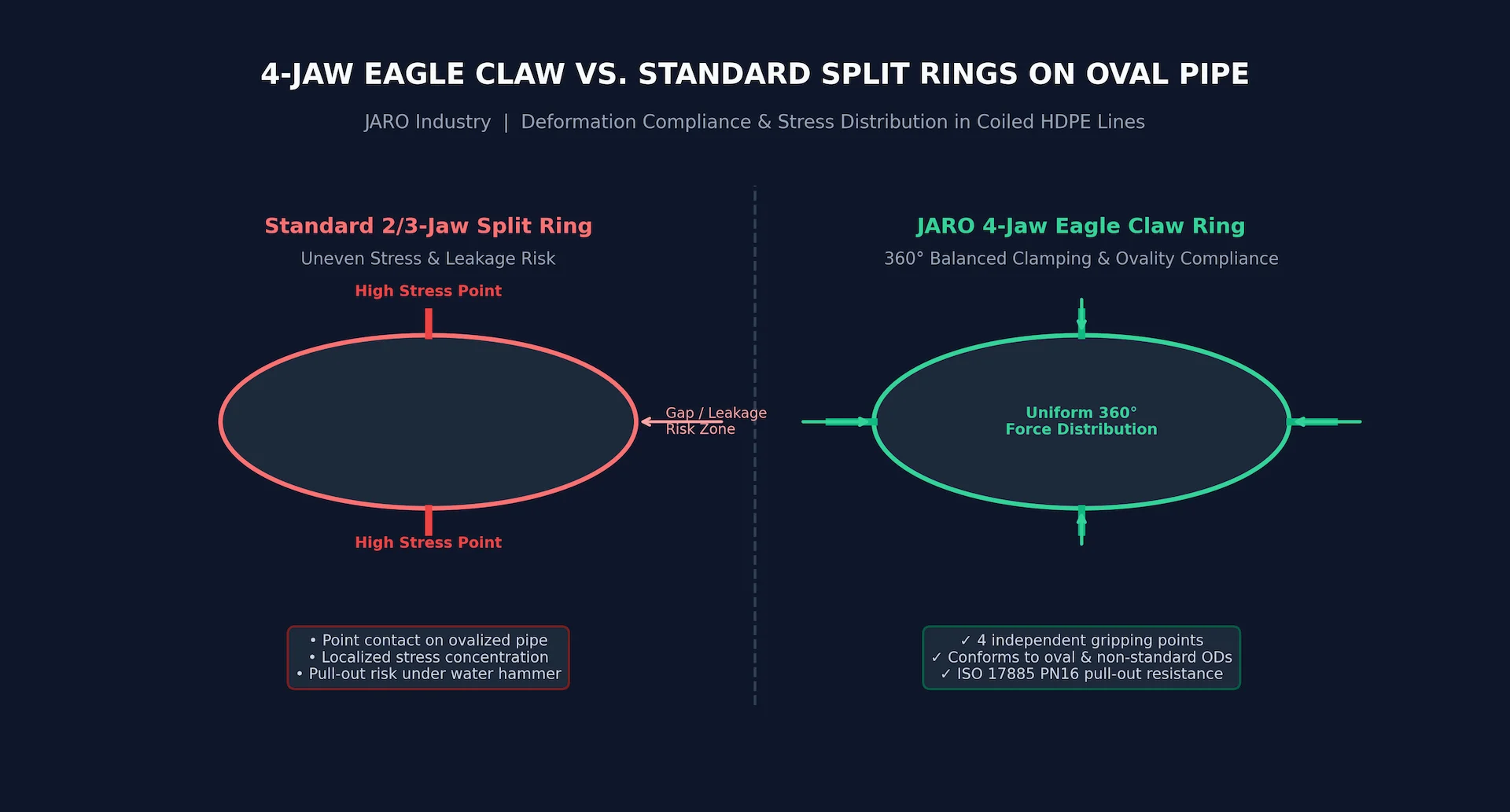
Stress Distribution & Ovality Compliance Comparison: Standard C-Type Split Rings vs. JARO 4-Jaw Eagle Claw Split Ring.
2. Engineering Solution: The Mechanics of 4-Jaw Eagle Claw Split Rings
To overcome pipe pull-out and conform to non-standard or ovalized pipe geometries across couplings, elbows, and branch connections such as the JRP05 PP Compression Reducing Tee, JARO PP Compression Fittings utilize an advanced 4-Jaw Eagle Claw split ring design.
FEATURE 01
360° Balanced 4-Point Grip
Divides clamping perimeter into four independent, symmetrically balanced segments that wrap uniformly around the pipe circumference.
FEATURE 02
Self-Locking Tension Mechanics
Angled claw teeth convert axial pull-out forces directly into radial clamping force: the higher the pull force, the tighter the grip.
FEATURE 03
Pipe Ovality Adaptation
Flexing jaws conform dynamically to ovalized coiled HDPE pipes, ensuring the EPDM O-ring maintains uniform 360° seal pressure.
3. Engineering Verification & ISO Quality Standards Compliance
Mechanical piping components must undergo rigorous physical testing to verify tensile pull-out resistance and long-term pressure tightness under environmental stress.
A. Pull-Out Resistance Testing (ISO 17885 / ISO 14236)
Per ISO 17885 Clause 7.2, assembled mechanical compression joints are subjected to a constant axial tensile load calculated using the standard stress formula:
F = σ · π · t · (dn - t)
Where σ is the test stress (set between 8.0 MPa and 12.0 MPa depending on PE pipe grade), t is nominal wall thickness, and dn is nominal pipe diameter. The joint must withstand this continuous axial force at 20°C for 1 hour with zero pipe pull-out or joint slippage exceeding permissible limits (< 2.0 mm).
B. Bending Resistance Under Hydrostatic Pressure
To simulate soil movement or thermal expansion in the field, assembled fittings are deflected to a forced bending radius while pressurized to 1.8 × PN (28.8 Bar for PN16 fittings) for 1 hour per ISO 14236. The 4-jaw eagle ring maintains structural clamping throughout deflection, preventing O-ring unseating.
4. Technical Specifications & Standard Performance Data
The table below summarizes performance parameters and testing requirements for PN16 rated PP compression fittings equipped with 4-jaw eagle claw split rings:
| SPECIFICATION / PARAMETER | ISO 17885 / ISO 14236 STANDARD REQUIREMENT | JARO 4-JAW DESIGN ADVANTAGE |
|---|---|---|
| Working Pressure Rating | PN16 (16 Bar / 232 PSI) at 20°C | Full PN16 structural compliance across DN20 to DN110 sizes |
| Axial Pull-Out Resistance | 1 Hour constant tension load without pipe slippage (> 8.0 MPa stress) | 4-Jaw eagle claws convert axial pull into radial locking force |
| Pipe Ovality Adaptation | Joint tightness maintained under standard pipe out-of-roundness | 4 Flexing segments conform to ovalized coiled HDPE pipe ends |
| Hydrostatic Pressure Strength | Burst testing at > 3.0 × PN; sustained pressure for 1,000 hrs | High-grade UV-stabilized Polypropylene virgin compound body |
| Sealing Element | Drinking water safe EPDM / NBR elastomeric O-ring | High-resilience EPDM O-ring for dynamic leak-free sealing |
5. Standardized Installation Protocol for Coiled & Ovalized HDPE Pipes
To ensure 100% leak-free performance when installing PP compression fittings on coiled or non-standard HDPE pipes, follow these four field assembly steps:
- Square Cut & Chamfer: Cut the HDPE pipe perpendicular to its axis using a pipe cutter. Chamfer the outer pipe edge at a 15° angle to prevent damaging the internal EPDM O-ring during insertion.
- Check Ovality: Inspect the pipe end. If coiling has caused severe ovality, use a pipe reforming tool or press gently to restore initial roundness before inserting into the fitting socket.
- Full Insertion Depth: Mark the socket depth on the pipe outer wall. Push the pipe firmly past the 4-jaw split ring and O-ring seal until it hits the internal socket shoulder stop.
- Torque Tightening: Hand-tighten the outer nut, then use a specialized PP fitting wrench to complete tightening until the threads lock firmly. Avoid over-torquing beyond recommended limits.
Need CAD Models or Bulk Quotations for Irrigation Projects?
Explore JARO’s complete range of PP compression fittings, including the JRP05 Reducing Tee, JRP21 Male Compact Valve, and JRP22 Female Compact Valve for full fluid control reliability.
Frequently Asked Questions (FAQ)
Can PP compression fittings with 4-jaw eagle claw split rings be reused?
Yes. PP compression fittings can be disassembled by unscrewing the outer nut. However, before reassembling onto a new pipe section, inspect the 4-jaw split ring and EPDM O-ring for mechanical wear or grit contamination, replacing sealing components if necessary.
How does the 4-jaw eagle claw handle ovalized coiled irrigation pipes?
The four independent jaws flex symmetrically to distribute clamping pressure around the ovalized perimeter rather than pinching two opposite points like single-slot C-rings. This balanced contact helps seat the pipe uniformly against the internal EPDM seal.
Are JARO PP compression fittings suitable for outdoor UV exposure?
Yes. JARO PP compression fittings are manufactured using high-purity virgin Polypropylene enriched with UV stabilizers and carbon black additives, preventing photo-oxidative degradation during long-term outdoor sunlight exposure. Learn more about PP compression fittings weatherability and outdoor performance.